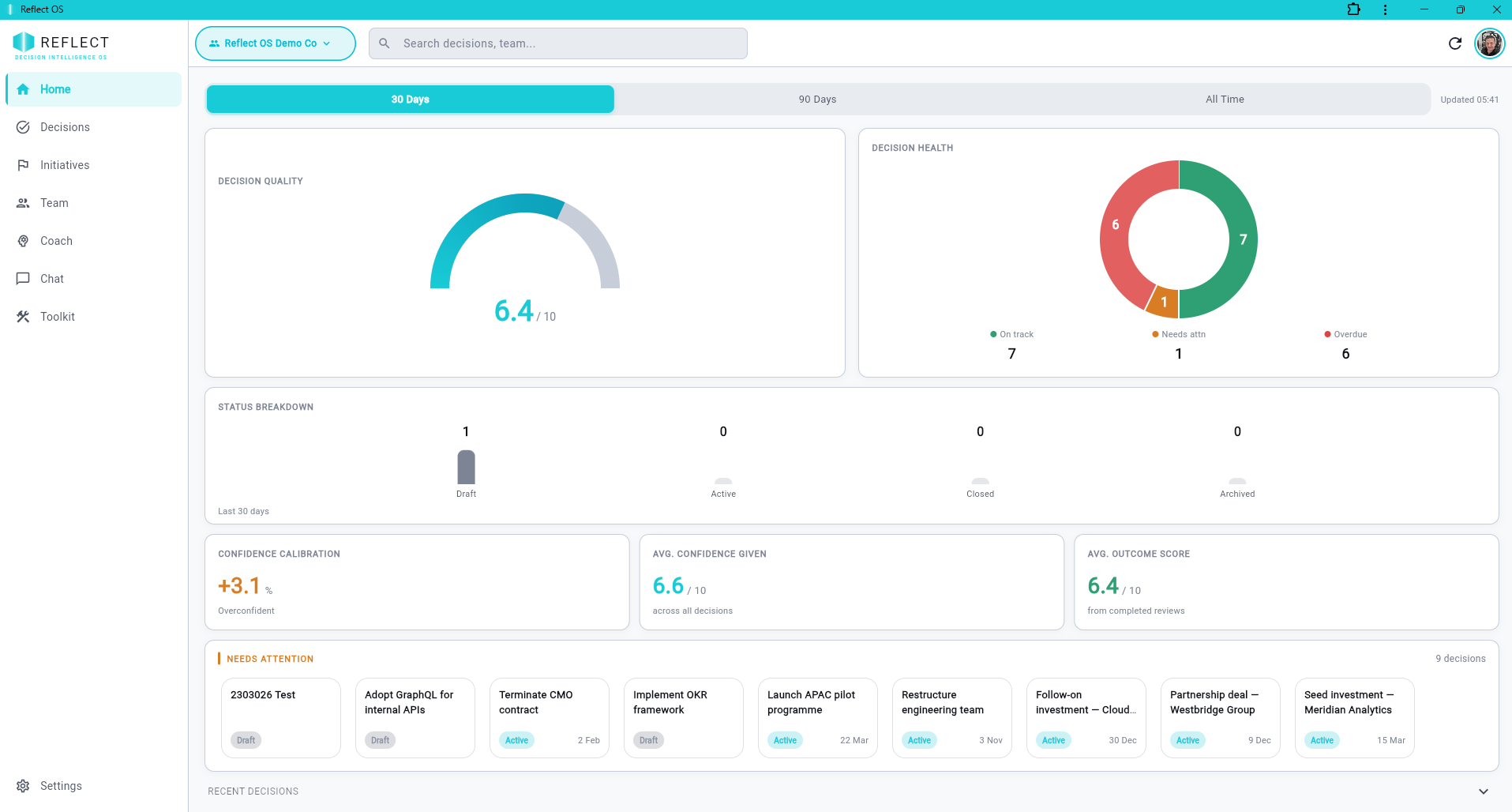
The Reflect OS dashboard — decision health, calibration score, and upcoming reviews at a glance
You make 8–12 consequential decisions a month. Most of the reasoning behind them disappears within weeks. Reflect OS is where that reasoning lives — and where it becomes a learning resource.
Reflect OS gives executives a structured system to log decisions with rationale and confidence ratings, then automatically prompts 30/90/180-day outcome reviews. Over months, it calculates your calibration score by decision type — showing precisely where your judgment is reliable and where systematic biases are costing you.
When a senior person leaves, their decision-making logic leaves with them. Reflect OS makes reasoning portable — captured in a structured format that outlasts any individual.
When stakeholders ask "why did we choose this approach?", the reasoning gets reconstructed from memory — which is unreliable and self-serving. Reflect OS stores the real answer.
You suspect patterns in your own decision-making — overconfidence under time pressure, sector-specific optimism — but you can't measure them. Until now.
Teams repeat the same errors because there's no structured feedback loop connecting decisions to their outcomes. Reflect OS closes that loop.
New leaders inherit documents, not decision history. Reflect OS gives incoming leaders the context they need to understand why things are the way they are.
Reviews happen in isolation, rarely linked back to the original decision context. With Reflect OS, every outcome review is anchored to what was actually decided and why.
The Reflect OS dashboard — decision health, calibration score, and upcoming reviews at a glance
"What else was happening when you made this decision?" is the question that unlocks honest self-assessment. This single field changes the quality of everything you review later.
Share decision context with a board member, advisor, or stakeholder who isn't a Reflect OS user. They get a clean, readable brief with a link that expires on your schedule.
What's due this week, your rolling quality score trend, and one observed pattern. Three items. No noise. The kind of Monday morning briefing that actually changes how you think about the week ahead.
Not every email reply warrants a decision log. The five categories that move the needle — and where systematic review produces the highest return — are:
Reflect OS lets you tag decisions by category so calibration scores are calculated per type. Most executives discover they are well-calibrated in one or two categories and systematically biased in others — and this insight is invisible without structured logging.
The average C-suite executive makes between 35 and 70 significant decisions every week. Most of those decisions are never formally reviewed. When outcomes diverge from expectations — and they always do — the reasons are rarely examined systematically. The result is a cycle of repeated mistakes, uncalibrated confidence, and institutional knowledge that disappears when people leave.
Reflect OS breaks this cycle by creating a structured, searchable record of every significant decision: what you decided, why, how confident you were, and what actually happened. Over time, this record becomes one of your most valuable assets.
A CEO logs a hiring decision for a new VP of Sales. They record their initial confidence (7/10), their expected outcome (hitting £2M ARR within 12 months), and their reasoning. Ninety days later, Reflect OS prompts them to review. Six months after that, they review again. After twelve months, the decision has a full outcome record.
Across dozens of decisions, patterns emerge. Perhaps the CEO consistently overestimates the speed of commercial hires. Perhaps their confidence is well-calibrated on operational decisions but inflated on strategic ones. These insights — invisible without a systematic record — become the foundation of measurably better judgement.
Confidence calibration tracking: Reflect OS measures the gap between your predicted confidence and actual outcomes across every decision category. Overconfidence in hiring, underconfidence in pricing changes, excellent calibration in operations — you see it all clearly over time.
Team decision workspaces: Share decisions with your leadership team, assign stakeholder roles, and capture the deliberation process before a decision is made. The full record — including dissenting views and the reasoning behind the final call — is preserved permanently.
Review checkpoints: Every decision can have scheduled review points (30, 90, 180 days). Reflect OS sends reminders and structures the review process so outcome data is captured consistently, not just when it is convenient.
Decision health dashboard: At a glance, see which active decisions are on track, which need attention, and which are overdue for review. Decision intelligence becomes a weekly management habit, not an annual retrospective.
McKinsey estimates that poor decision-making costs large organisations 530,000 working days of management time per year. For a 500-person company, that is roughly £250M in lost productivity annually — entirely from avoidable decision failures. The root cause is almost always the same: no systematic process for capturing, reviewing, and learning from decisions at scale.
Reflect OS is the infrastructure layer that makes systematic decision improvement possible. Start with a 90-day free trial — no credit card required until you are certain it is working.